A patient website redesign that puts caregivers first, replacing regulatory language with the clarity people need most.
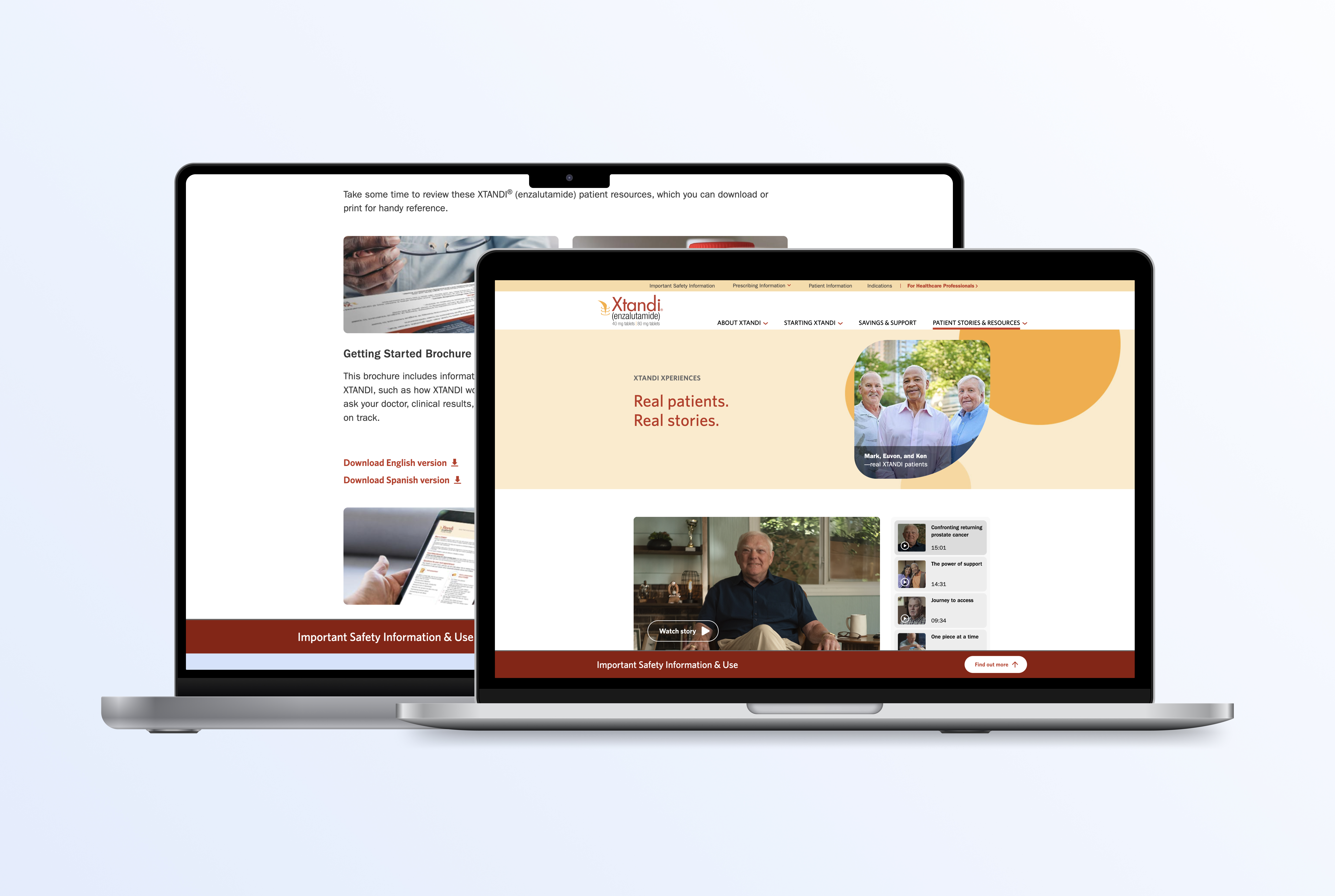
XTANDI.com: patient and caregiver website redesign
Partnered with the Xtandi marketing team to revamp their patient website across mobile and desktop, ensuring FDA compliance, updating content, and enhancing educational resources. Delivered a patient-centric digital experience through UX/UI design, journey mapping, multilingual support, and SEO improvements, now live on XTANDI.com.
"My husband was just diagnosed. I needed to understand what this medication would do to him. The website gave me legal disclaimers."
Caregiver, XTANDI Patient ResearchA compliance deadline, an inaccessible site, and patients who needed both.
Following Xtandi's FDA approval for treating Metastatic Castration-Sensitive Prostate Cancer (mCSPC), the brand faced regulatory requirements to remove all "new" language from its communications within six months. The existing website also lacked adequate multilingual support and SEO optimization, limiting its reach and effectiveness for patients and caregivers. Additionally, content from former brand ambassadors Dennis and Theresa needed to be removed or replaced. The challenge was to ensure regulatory compliance, provide accessible educational resources in Spanish and Mandarin, and optimize site structure and content for SEO, all while maintaining the established Xtandi brand look and feel.

Janice Patterson
Caregiver (Spouse)
"I need clear, accurate information to support my husband's treatment decisions, and I want to find it easily."
[Goals]
Quickly find trustworthy information about Xtandi treatment and financial support options.
Access resources in preferred languages (Spanish or Mandarin).
Ensure content is clear, easy to navigate, and up-to-date.
[Frustrations]
Confusing site navigation and difficulty finding answers to common questions.
Lack of translated materials to support non-English speaking patients.
Outdated content that creates uncertainty about treatment information.
[01] User Research
Conducted interviews with caregivers and patients to understand information gaps and language needs.
Analyzed site traffic and drop-off points to identify areas of friction in the user journey.
Collaborated with compliance and regulatory teams to ensure accuracy and FDA alignment.
[02] Insights
Users were confused by outdated ambassador content and required clearer guidance on treatment options.
Multilingual resources were critical for accessibility and patient education.
Adding SEO-optimized FAQs and video transcripts would improve both searchability and user comprehension.
[03] Design Solution
Removed all outdated ambassador content (Dennis and Theresa) and replaced it with generalized educational materials.
Added FAQs and video transcripts to improve SEO and provide clear, accessible patient information.
Introduced Spanish and Mandarin translations of key resources and prescribing information to broaden reach.
[04] Testing & Iteration
Gathered feedback from Pfizer/Astellas internal stakeholders to confirm compliance and brand consistency.
Refined language and content hierarchy based on iterative rounds of testing and SEO analysis.
Compliance-led, patient-first.
Every design decision ran through a compliance check first, which meant the project required a different kind of sequencing than a typical redesign. Rather than building toward an ideal and then checking compliance, we built a compliance map before any wireframes, and used it as the creative constraint.
"For the first time I could actually navigate to what I was looking for without reading through a wall of regulatory text first."
Caregiver, post-launch usability testingRedesigned XTANDI patient site: live walkthrough
Information architecture
Restructured the site around patient and caregiver mental models rather than regulatory product categories. The primary navigation was reorganized to answer the questions users actually arrived with: What is XTANDI? Is it right for me? What do I need to know before starting? Each section was mapped to a user question before content was assigned.
Ambassador content transition
Worked with the marketing and legal teams to develop a phased content removal plan that minimized the window where outdated content would be live. Replacement content was written, reviewed, and approved before the ambassador content came down, so users never landed on an empty page.
Multilingual resources
Introduced Spanish and Mandarin translations of key resources and prescribing information, adapted for the reading level and research context of each language's primary audience rather than translated word-for-word from English. Multilingual entry points were surfaced in the navigation rather than buried in a footer link.
SEO and accessibility
Added FAQ sections with structured markup to improve search visibility and in-page comprehension simultaneously. Added video transcripts for all embedded content, improving accessibility for older users and providing indexable content for search. Readability guidelines were applied across all body copy with older users as the primary benchmark.
FDA Compliance
Delivered all required content updates within the 6-month FDA regulatory deadline, ensuring legal and brand compliance.
Increased Engagement
Improved multilingual resources and clearer navigation led to higher engagement rates among Spanish and Mandarin-speaking users.
Improved SEO 35%
SEO optimization through structured FAQ content and video transcripts increased organic search traffic by 35% in the first quarter post-launch.
Regulatory Compliance Must Lead Design
Early collaboration with legal and compliance teams prevents late-stage rework. In heavily regulated contexts, constraint mapping before wireframing is not optional.
Multilingual Access is Essential
Providing resources in the user's language improves comprehension and satisfaction. For caregivers navigating a serious diagnosis, finding information in their language is a health outcome, not a UX metric.
SEO and UX Go Hand in Hand
FAQ structures and video transcripts improved both searchability and in-page comprehension simultaneously. The most useful content for users and the most findable content for search turned out to be the same content.